MDF, Particleboard or Plywood: How to Tell What's Inside a School Desk
In a school desk quotation, the board is rarely the largest line. It is the line buyers ask about least, and the one that decides what the classroom looks like in year three.
Almost every desk top on the market is one of three boards: MDF, particleboard or plywood. Telling them apart is not a laboratory job. A cut edge, a screw hole and half a cup of water will do it — provided you look at the part of the desk nobody photographs.
What each board actually is
MDF (medium-density fibreboard) is wood fibre broken down and pressed with resin into a uniform sheet. No grain, no direction, consistent density through the thickness. It machines and paints cleanly, which is why it ends up on surfaces people look at.
Particleboard (chipboard) is wood chips and mill waste pressed with resin. The core is coarse, the density lower, and the surface is only as flat as the sanding line made it.
Plywood is thin veneers glued in alternating directions, usually an odd number of plies. Crossing the grain is what gives it strength in both directions, and it is why plywood behaves differently from the other two at the edge.
| Board | Cut edge | Screw holding | A spilled cup | Typical use in a desk |
|---|---|---|---|---|
| MDF | Uniform, no grain, fine fibres | Good once, poor if re-driven | Edge swells and stays swollen | Tops, drawer fronts, painted panels |
| Particleboard | Chips of visibly different sizes | Weakest — a hinge screw will not hold a second time | Swells fast and crumbles at the edge | Low-cost tops, shelves, carcasses |
| Plywood | Parallel veneer lines, plies crossing | Best at the edge, good through the face | Delaminates once water reaches an open edge | Structural panels, frames, tops |
None of the three is a bad board. All three are specified somewhere and all three fail in a predictable way. The problem starts when the quote says "18 mm board" and nobody asks which one.
The edge decides more than the board
Two tops, one in 18 mm MDF and one in 25 mm particleboard, both feel solid on the pallet. In a classroom the first failure is almost never the face. It is the edge: a chair pushed in forty times a day, water from a mopped floor, a child picking at a strip that has already lifted.
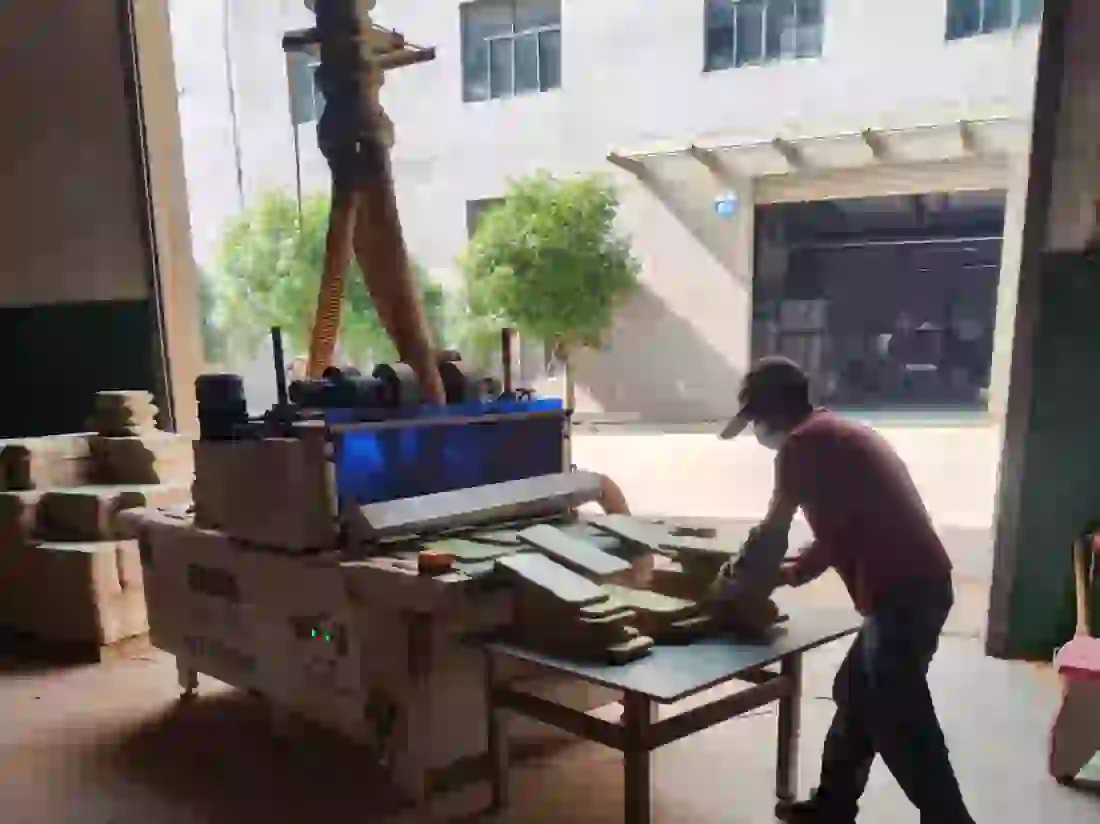
Banding is where cost disappears quietly. A 0.4 mm PVC tape with hot-melt glue is cheap and perfectly serviceable — if the glue line is continuous and the corners are radiused rather than wrapped over a sharp one. The sharp corner is always the first place to peel.
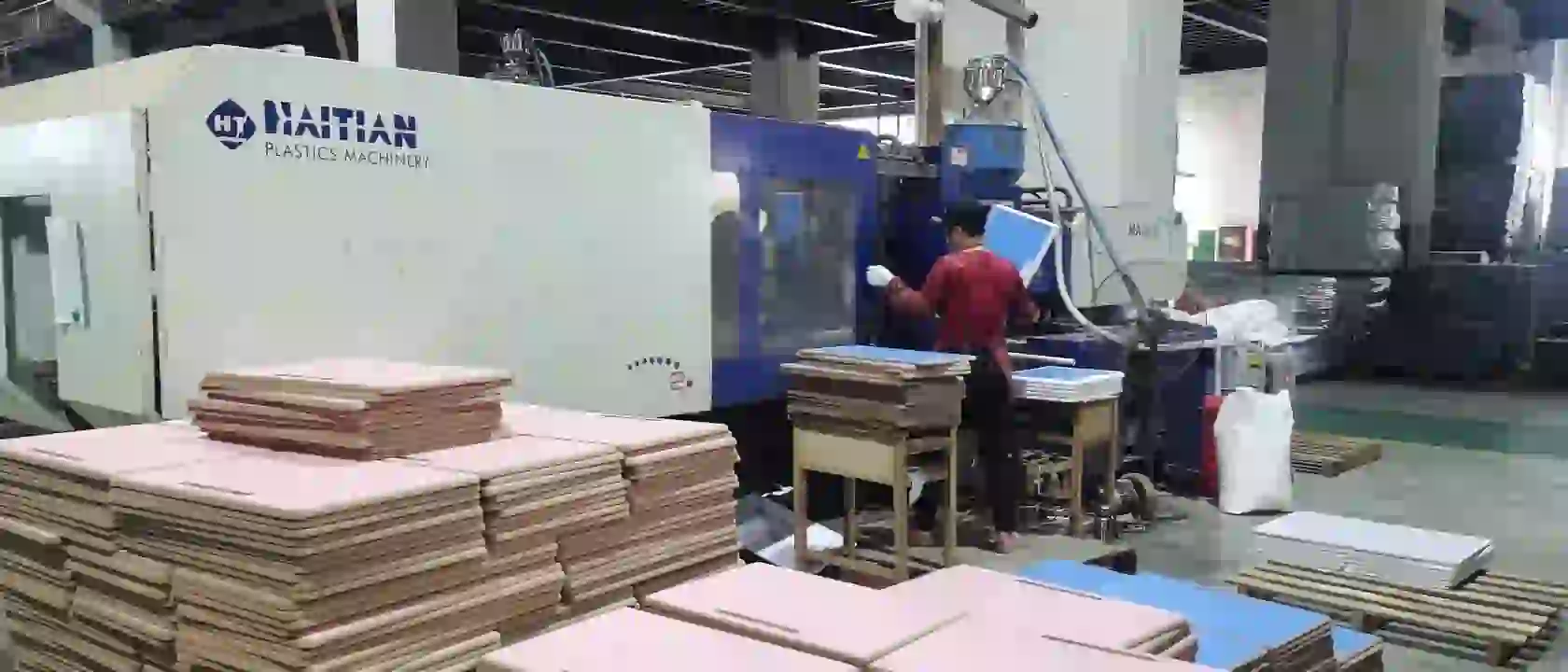
The other option is to mould the edge instead of gluing it: the board is cut, cleaned and dried, then plastic is injection-moulded around the cut edge so the rim is locked on mechanically. There is no glue line to fail and no strip to pick at. It costs tooling and cycle time, and it is the reason a cheap top and a school-grade top can look identical in a photo and behave nothing alike after two years.
Four checks you can run in ten minutes
You do not need a laboratory, and you should not accept a photo. Pull one unit out of a carton and do four things.
- The screw test. Take out one hinge or bracket screw, drive it back in, then out and in again. In particleboard the second re-drive spins. In MDF it holds twice and then starts to crumble. In plywood it holds, because the screw is biting across plies.
- The water test. Put a drop of water on an exposed cut edge — an offcut, or the underside where the banding ends. Wait thirty minutes. MDF and particleboard swell at the edge and stay swollen after drying; plywood only fails once water reaches the plies. The swelling is permanent, and a swollen edge cannot be sanded back to thickness.
- Look at the edge under raking light. Light across the edge, not at it. A glued band shows a glue line and a slight step. MDF shows a uniform fibrous face, particleboard shows chips of different sizes, plywood shows parallel lines.
- Lift one top. Density is roughly 700–800 kg/m³ for MDF, 600–700 for particleboard, and lower and more variable for plywood at the same thickness. A top that feels light for its size is low-density particleboard, whatever the label says.
What the paperwork has to say
Three lines on a specification sheet do more work than any amount of sales copy.
- Formaldehyde class, with the method. For the EU, EN 717-1 chamber testing and class E1, which is 0.124 mg/m³. For the US, CARB P2 / TSCA Title VI. If a supplier quotes "E0", ask which method and which limit — E0 is used widely in China, but it is not a class defined in EN 717-1.
- Thickness swelling, by number. "Moisture resistant" and "waterproof" are not specifications. Ask for 24-hour thickness swelling to EN 317 and the measured value, per board type.
- Board specification per model. Grade, nominal thickness, density, and whether the top is one board or a frame with a skin. This is the line that stops the board from being swapped for a cheaper one between the sample and the container.
What the board does not decide
The board is one of about six things that decide whether a desk survives a school. Frame tube wall thickness, weld quality and whether the welds were dressed, powder-coating thickness and adhesion, the height-setting mechanism, and assembly — a good top on a weak frame is still a bad desk.
If you are writing a tender, the dimensions half of that list is covered in our guide to EN 1729 size marks, which is the document a European buyer will check first.
FAQ
Is thicker always better?
Not on its own. Bending stiffness rises with the cube of thickness, so 25 mm is about 2.7 times stiffer than 18 mm of the same board — but moving from MDF to particleboard at the same thickness gives most of that back.
Can I tell from the product photo?
No, and a supplier who says you can is selling you the photo. The board is only visible where the desk is cut.
Is solid wood better?
It is different. Solid wood moves with humidity, so it needs a frame that allows the movement; done badly it cracks and gaps. A well-sealed MDF or plywood top is the more predictable choice for a school, not the cheaper one.
What do you use?
It depends on the model and on the quote. Ask us for the board specification of the model you are pricing and we will send it with the thickness-swelling and formaldehyde test reports for that board.
QiWeiSheng manufactures school desks and chairs and home study desks in Jiangxi, China. Every model we quote has a written board specification; ask for it before you compare prices.
QiWeiSheng · OEM / ODM · Jiangxi, China