EN 1729 Size Marks Explained: Seat Height, Table Height, and How to Check Them Before You Order
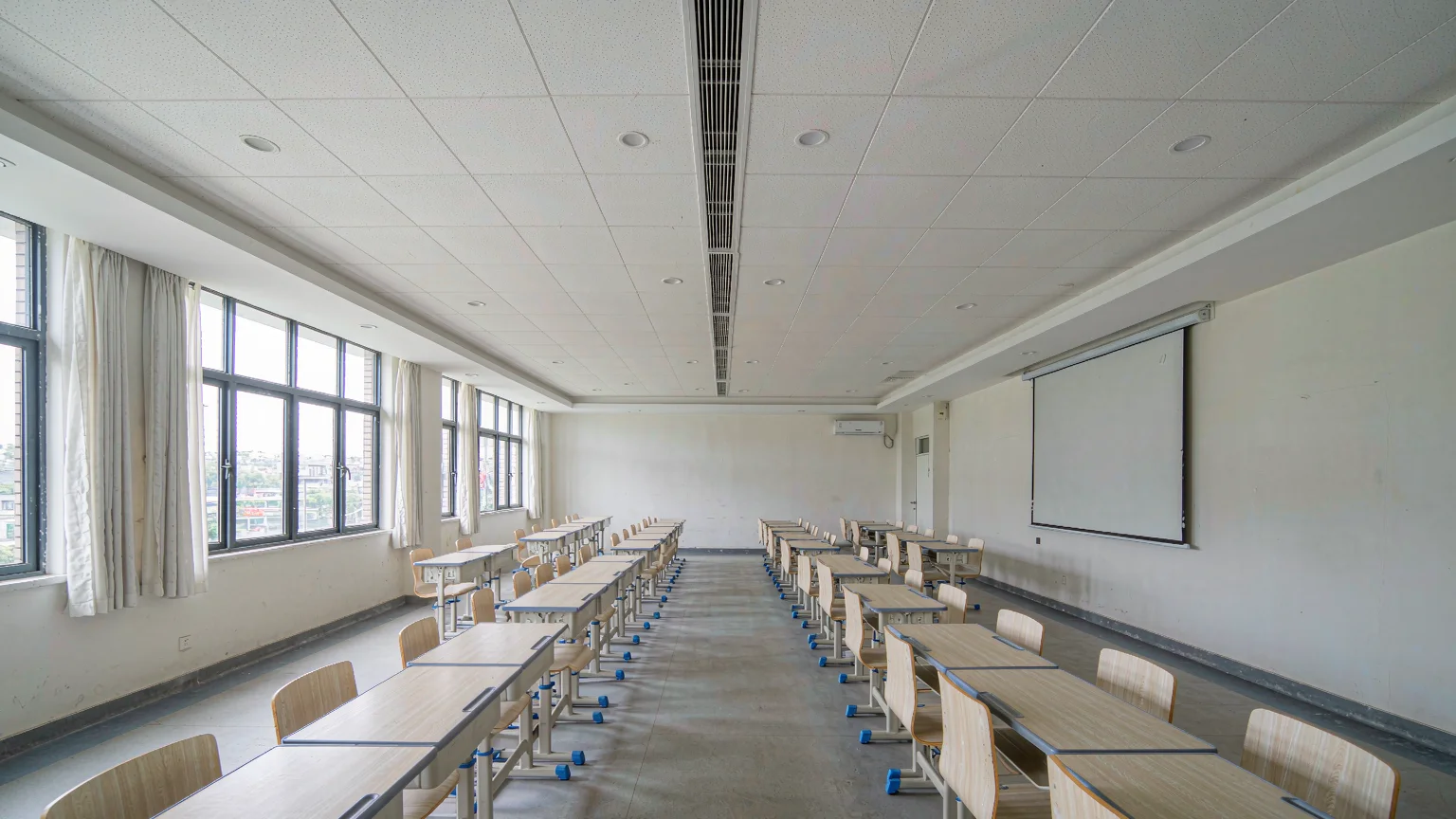
If you are sourcing school desks and chairs for a European tender, the most expensive mistake is not a broken weld. It is ordering "standard height" furniture.
There is no standard height. EN 1729-1 defines seven size marks, and each mark fixes a chair seat height and the table height that goes with it, as a pair. Get the pair wrong and nothing fails inspection, nothing gets rejected at the port — the furniture simply fits nobody, quietly, for the next ten years.
This guide gives you the table, the three ways buyers usually misread it, and a five-point check you can run when the container is opened.
What a size mark actually defines
EN 1729-1:2015 is the functional-dimension part of the European standard for furniture used in educational institutions. Rather than one size, it defines marks 1 to 7. Each mark binds a stature range to a seat height and a table height.
| Size mark | Colour | Pupil stature (mm) | Chair seat height (mm) | Table height (mm) |
|---|---|---|---|---|
| 1 | Orange | 800 – 950 | 210 | 400 |
| 2 | Violet | 930 – 1160 | 260 | 460 |
| 3 | Yellow | 1080 – 1210 | 310 | 530 |
| 4 | Red | 1190 – 1420 | 350 | 590 |
| 5 | Green | 1330 – 1590 | 380 | 640 |
| 6 | Blue | 1460 – 1765 | 430 | 710 |
| 7 | Brown | 1590 – 1880 | 460 | 760 |
Two properties of this table matter more than the numbers themselves.
The stature ranges overlap on purpose. A child of 1200 mm fits mark 3 and mark 4. The overlap is not a drafting error — it lets a school place a pupil near a boundary in either size depending on what is already in the room. It also means the stature column is guidance for planning a room, not a specification you can order against.
Seat height and table height are defined together. A mark is not a chair size or a table size. It is a matched pair. This is the part most purchase orders get wrong.
Three ways buyers misread it
1. Converting age to a mark
Searches for "what size desk for a 9 year old" return age tables. Those tables are a convenience invented by retailers, not part of the standard. In any single Year 4 class you will find children spanning two size marks, sometimes three. Order by age band and you will be short of one size and long on another every time.
If you must plan by year group, take the actual stature distribution from the school — most education ministries publish it — then map to a primary mark plus one adjacent mark as overflow.
2. Pairing a mark 3 chair with a mark 4 table
This happens constantly when chairs and tables are bought as separate line items from different suppliers. It produces exactly the posture problem the standard exists to prevent: the table is 6 cm higher than the chair was designed for, the child's shoulders lift, and the writing position collapses forward.
Chairs and tables must be ordered at the same mark. If you split the order between suppliers, put the mark in both POs and check the goods against it on arrival.
3. Accepting "EN 1729 compliant" without asking which part
EN 1729 has two parts. Part 1 is dimensions. Part 2 (EN 1729-2:2012) is safety, strength and durability — stability, static load, cycling, drop testing, entrapment and edge radii.
A supplier quoting "EN 1729 compliant" may be telling you only that the dimensions match, which says nothing about whether the frame survives a decade of classroom use. Ask for both parts, and ask for the test report rather than a declaration. There is no CE marking for school furniture; the test report from an accredited laboratory is the only document that means anything in a claim.
Where height-adjustable models fit
Adjustable furniture is where the standard is most often misapplied, including by factories that ought to know better.
An adjustable frame typically spans two or three marks. Our own school desk range, for example, ships with a desk height range of 660–760 mm and a seat height range of 360–420 mm. Read against the table above:
- The desk range of 660–760 mm reaches mark 5 (640) at the bottom and mark 7 (760) at the top.
- The seat range of 360–420 mm sits between mark 4 (350) and mark 6 (430).
So the desk can physically reach mark 7 while the seat cannot. If you set that combination to its maximum and call it "mark 7 furniture", you have a table 760 mm high with a seat 40 mm lower than mark 7 requires — the child ends up reaching up to write.
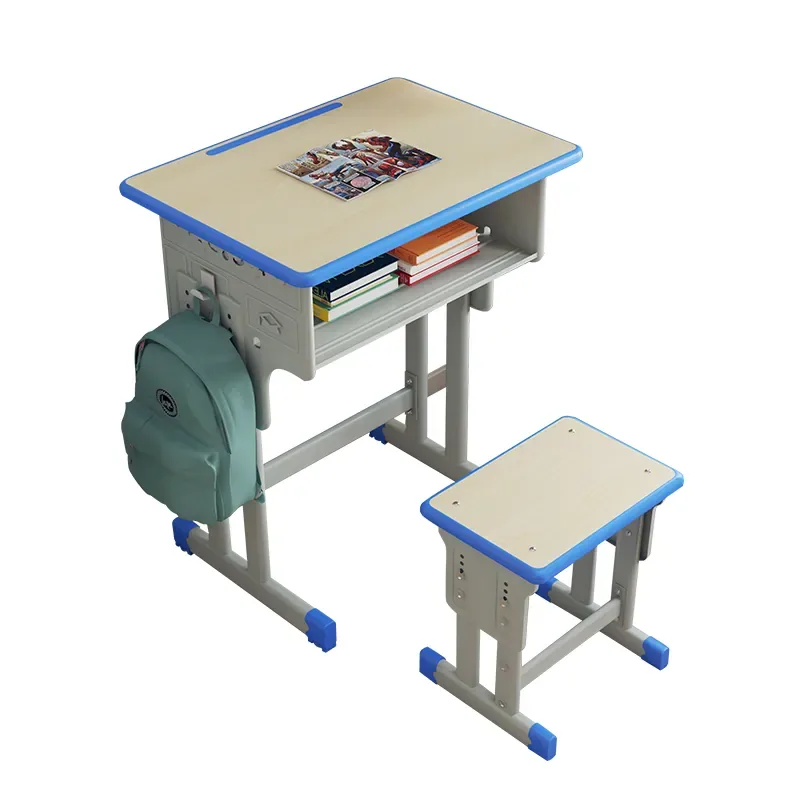
Adjustable does not mean compliant. It means the range has to be pinned to one mark before delivery: set the frame, lock it, and mark the unit. A useful tender clause is:
Furniture shall be supplied set to the size mark specified per room schedule, each unit permanently marked with its size mark in accordance with EN 1729-1, and the locked setting verified at goods-in.
Adjustable still wins on whole-life cost, because one frame covers a school's growth and room changes. It just needs the setting to be a documented instruction rather than an afterthought.
Five checks at goods-in
You do not need a laboratory to catch the expensive errors. You need a tape measure, twenty minutes, and one unit pulled at random from each mark on the packing list.
- Measure seat height. From the floor to the middle of the front edge of the seat, uncompressed. Do not measure from the seat to the tabletop — that is a different number and it is not what the standard specifies.
- Measure table height. Floor to the top surface, at the centre, with the unit standing on a flat floor.
- Find the permanent size mark. It should be moulded, stamped or etched on the chair, not on a sticker that falls off in the first term. A tender clause that requires permanent marking is worth more than it looks.
- Ask for the Part 2 test report, not just dimensions. Check the report covers the model you actually received, not a sister model.
- Check consistency across the batch. On an order of 500 sets, the failure mode is rarely "all wrong" — it is 30 units from a second line set to a different mark. Sample from at least three cartons per mark.
What to put in the purchase order
Most disputes come from ambiguous wording, not from bad furniture. Four lines close most of the gap:
- The size mark per room, and the number of units at each mark.
- Whether chairs and tables are supplied as matched sets at the same mark.
- The required test reports, by part, by model.
- The setting for any adjustable unit, and that it must be marked and locked.
FAQ
Is there a size mark 0?
No. EN 1729-1 defines marks 1 to 7. Some published tables online start at 0 and shift every row down by one, so their "mark 2" is the standard's mark 1. If a supplier's catalogue starts at 0, check its numbers against the table above before you order.
Our market uses inches. Do we convert?
Convert for internal reference, but specify in millimetres. Half a millimetre of rounding across a container is how a matched set drifts into two different marks.
Can one adjustable size cover a whole primary school?
Not honestly. A range that spans three marks serves three year groups well and the two beyond it badly. Mixed-mark orders plus adjustable frames in the rooms that change use every year is the cheaper configuration over ten years.
Do we need every mark in every room?
Almost never. Most schools run mark 2 to 5 in primary rooms and 5 to 6 in secondary. Marks 1 and 7 are nursery and adult furniture and are usually bought in small quantities.
QiWeiSheng manufactures school desks and chairs and home study desks in Jiangxi, China. Our school range ships with documented height ranges; ask us for the dimension sheet for any model and we will map it to the size marks above.
QiWeiSheng · OEM / ODM · Jiangxi, China